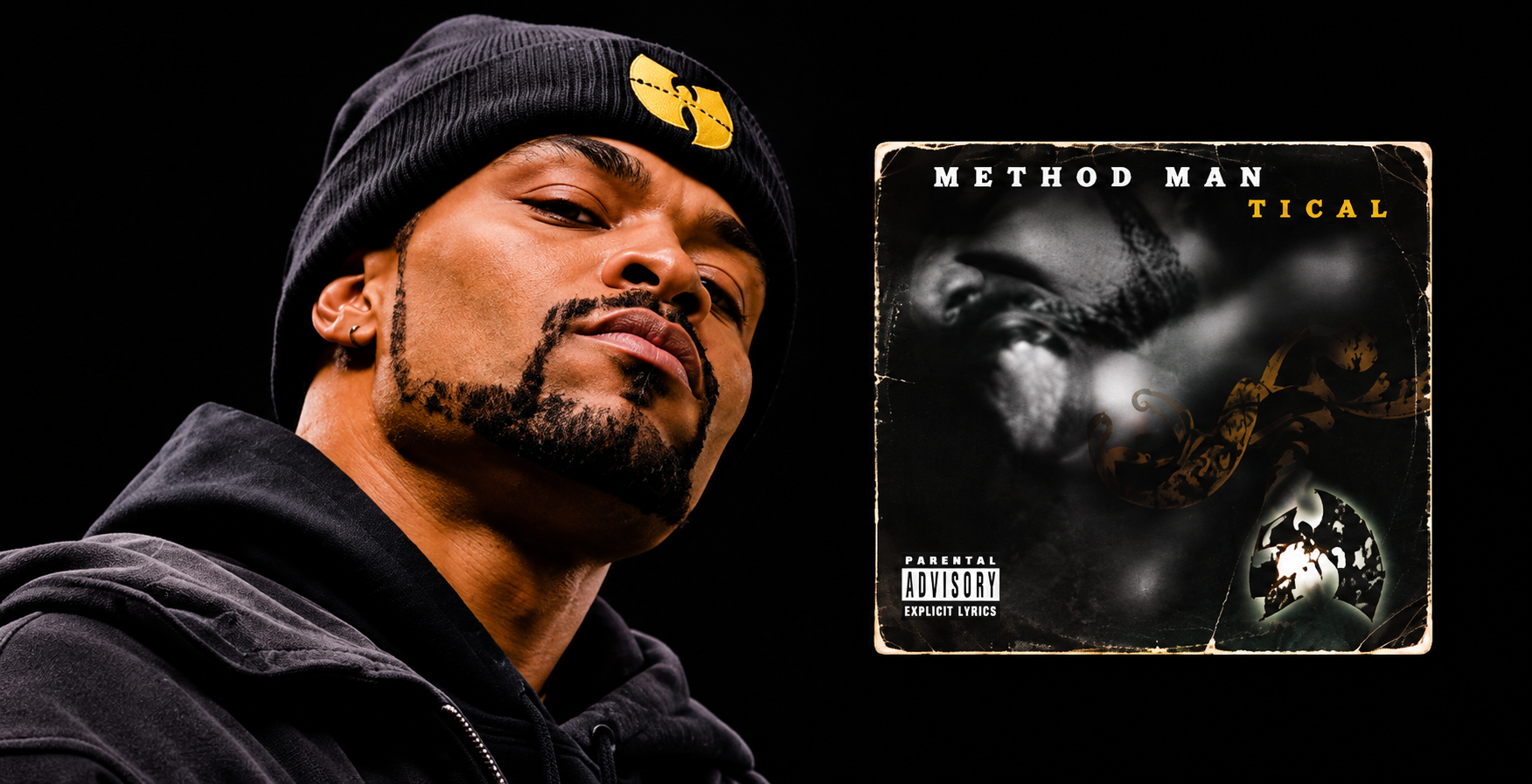
Dark, muddy, and far from what some fans expected. More than three decades later, Method Man’s solo debut remains one of Wu-Tang’s most debated albums. But was Tical really a disappointment, or have we been judging it unfairly all along?
The Most Anticipated Solo Debut in Wu-Tang
When Wu-Tang Clan dropped Enter the Wu-Tang (36 Chambers) in 1993, hip-hop would never be the same.
Nine distinct personalities, raw production, unforgettable verses, and an energy that nobody could duplicate. Wu-Tang wasn’t just another rap group. They were a movement.
And among all those personalities, one member stood out almost immediately: Method Man.
With his unmistakable raspy voice, effortless flow, charisma, and memorable solo track on 36 Chambers, Meth seemed destined for superstardom.
So when Tical arrived in November 1994 as the first Wu-Tang solo album following the group’s breakthrough, expectations were enormous.
But what listeners received wasn’t necessarily what everyone had imagined.
It was darker. Stranger. Murkier.
And for some, disappointing.
But here’s my question: Was Tical actually a disappointment, or did people simply expect a different album?
A Darker Album Than Many Expected
One of the biggest talking points surrounding Tical has always been its production.
RZA created an atmosphere that felt almost suffocating. The drums were gritty, the samples haunting, and the entire record seemed covered in a thick layer of smoke.
This wasn’t the polished, accessible solo debut some listeners might have expected from Wu-Tang’s most immediately charismatic member.
Instead, Tical sounded like it had been recorded in a cold Staten Island basement at three in the morning.
And that’s exactly what makes it special.
I can understand why some listeners were surprised by how dark the album sounded. Method Man had already established himself as one of the group’s most entertaining personalities. His delivery was playful, his punchlines memorable, and his presence magnetic.
Yet on Tical, much of that charisma was placed inside RZA’s bleak, grimy soundscapes.
For some fans, the production buried Method Man’s personality rather than allowing it to shine.
For me, it did the opposite.
That darkness gave Tical its identity.
The album doesn’t try to please everybody. It doesn’t chase a commercial sound. It creates its own world and refuses to leave it.
And that’s a huge part of why I still love it today.
Was Method Man the Right Wu-Tang Member to Go Solo First?
This is where the discussion gets interesting.
Was Method Man really the right choice to lead Wu-Tang’s solo movement?
From a commercial perspective, absolutely.
He had the voice, the personality, the recognition, and the ability to connect with listeners beyond Wu-Tang’s core audience.
But from a purely lyrical perspective, the Clan was overflowing with talent.
GZA was an extraordinary lyricist. Inspectah Deck could destroy almost any track. Raekwon and Ghostface Killah had a chemistry that would eventually become legendary.
And Ol’ Dirty Bastard was unlike anybody the rap world had ever seen.
So would another Wu-Tang member have delivered a stronger first solo statement?
Maybe.
But Method Man wasn’t chosen without reason. He had already proven he could carry an entire song while holding his own alongside some of the most talented MCs in New York.
And let’s not forget something important: Being the first meant carrying expectations that the others didn’t have to face in quite the same way.
There was no established blueprint for a Wu-Tang solo classic yet.
Tical helped create that blueprint.
The Wu-Tang Solo Albums That Followed
Let’s be clear about something.
Wu-Tang released an incredible series of solo projects during the mid-1990s.
Raekwon’s Only Built 4 Cuban Linx… gave listeners cinematic street storytelling and some of the most memorable production of the decade.
GZA’s Liquid Swords delivered sharp lyricism, dark production, and an almost flawless atmosphere. Although GZA had previously released Words from the Genius, Liquid Swords became his defining Wu-Tang-era solo statement.
Ol’ Dirty Bastard’s Return to the 36 Chambers: The Dirty Version was chaotic, unpredictable, funny, disturbing, and completely original.
Then Ghostface Killah arrived with Ironman, another outstanding debut that helped cement Wu-Tang’s legendary run.
Personally, I understand why many listeners rank some of those albums above Tical.
They’re incredible records.
But here’s where I disagree with certain hip-hop fans:
Just because Liquid Swords or Cuban Linx might be better albums doesn’t make Tical a bad one.
Hip-hop discussions often turn into unnecessary competitions.
One album becomes a universally celebrated classic, and suddenly another great record is treated like a disappointment simply because it isn’t considered the best.
That has never made sense to me.
Tical deserves to be judged for what it accomplished, not just for what came afterward.
Let’s Talk About the Records
If Tical was supposedly such a disappointment, how do we explain the music it gave us?
Bring the Pain
One of Method Man’s defining solo tracks.
The production is rugged, the delivery is effortless, and Meth glides over RZA’s beat with the confidence of somebody who knows exactly how good he is.
This is Method Man at his finest.
Release Yo’ Delf
An absolute banger.
The energy, the hook featuring Blue Raspberry, the commanding delivery, and that unmistakable Wu-Tang atmosphere make this one of the album’s standout moments.
It’s the kind of record that still sounds powerful decades later.
All I Need
The original album version showed a different side of Method Man.
Underneath the rough exterior was a rapper capable of showing affection without abandoning his personality.
The song later became an even bigger phenomenon through the I’ll Be There for You/You’re All I Need to Get By collaboration with Mary J. Blige.
That version helped introduce Method Man to an entirely different audience and became one of the most recognizable hip-hop and R&B collaborations of the 1990s.
And beyond those well-known tracks, the album has plenty more to offer.
Biscuits, What the Blood Clot, Sub Crazy, P.L.O. Style, Mr. Sandman, and Meth vs. Chef all contribute something to the album’s gritty identity.
Not every track needs to become a radio hit to make a great album.
Sometimes the deeper cuts are what keep a record alive.
The Production: Tical’s Biggest Weakness or Greatest Strength?
One of the most fascinating details surrounding Tical is the history of RZA’s basement flood.
According to accounts of the recording process, flooding damaged material connected to several early Wu-Tang solo projects, forcing some recordings and production work to be reconstructed.
Method Man has also discussed how these setbacks affected the album he originally envisioned.
It’s tempting to wonder what Tical might have sounded like without those problems.
Would the production have been cleaner?
Would it have contained different tracks?
Would fans have considered it a stronger album?
We will never know exactly what that alternative version might have been.
But personally, I wouldn’t want to erase the album’s dark atmosphere.
Those muddy drums, strange sounds, and eerie samples are part of its personality.
There’s something almost hypnotic about the production.
Tical sounds like 1994 New York hip-hop at its rawest.
And in a world where so much music eventually became polished and predictable, that rawness is worth celebrating.
Has Tical Aged Better Than People Give It Credit For?
This might be my strongest argument.
Some albums sound incredible when they’re released but lose their impact with time.
Others become more interesting the older they get.
For me, Tical belongs in the second category.
It still sounds dangerous. It still sounds mysterious. Method Man’s flow remains distinctive, and RZA’s production has an atmosphere that modern technology alone cannot recreate.
It doesn’t sound like an album desperately trying to fit into a trend.
It sounds like a record from its own universe.
And that’s why I can return to it today and still enjoy the entire experience.
Of course, I can recognize imperfections.
Some songs could have been developed further. The murky mixing occasionally makes the vocals less clear than they should be. And not every moment reaches the heights of its strongest tracks.
But a classic album doesn’t have to be technically perfect.
Sometimes its imperfections are part of what makes it unforgettable.
My Verdict: Tical Is a Personal Classic
I’m not here to argue that Tical is objectively better than Liquid Swords, Only Built 4 Cuban Linx…, or Ironman.
Those are conversations worth having separately.
I’m saying something much simpler.
Method Man released a great album in 1994, and that album still deserves respect today.
It gave us unforgettable tracks, established Method Man as a successful solo artist, and helped launch one of the greatest runs of solo albums in hip-hop history.
Was it darker than many fans expected? Absolutely.
Was it the flawless masterpiece some were hoping for? That’s debatable.
But was it a bad album?
Not even close.
For me, Tical has always been a personal classic, and more than 30 years later, it still holds up.
Maybe it’s time we stopped treating it like the disappointing younger brother of Wu-Tang’s more celebrated solo records.
Maybe it’s time we appreciated it for exactly what it is.
A dark, rugged, unforgettable piece of hip-hop history.
REAL TALK: WHAT DO YOU THINK?
Was Method Man the right Wu-Tang member to release the first solo album after 36 Chambers?
Is Tical genuinely underrated, or was it simply overshadowed by the incredible Wu-Tang albums that followed?
And most importantly:
Does Tical deserve to be mentioned alongside Wu-Tang’s greatest solo classics?
This is WhatsRap. Real hip-hop. Real opinions. No compromise.