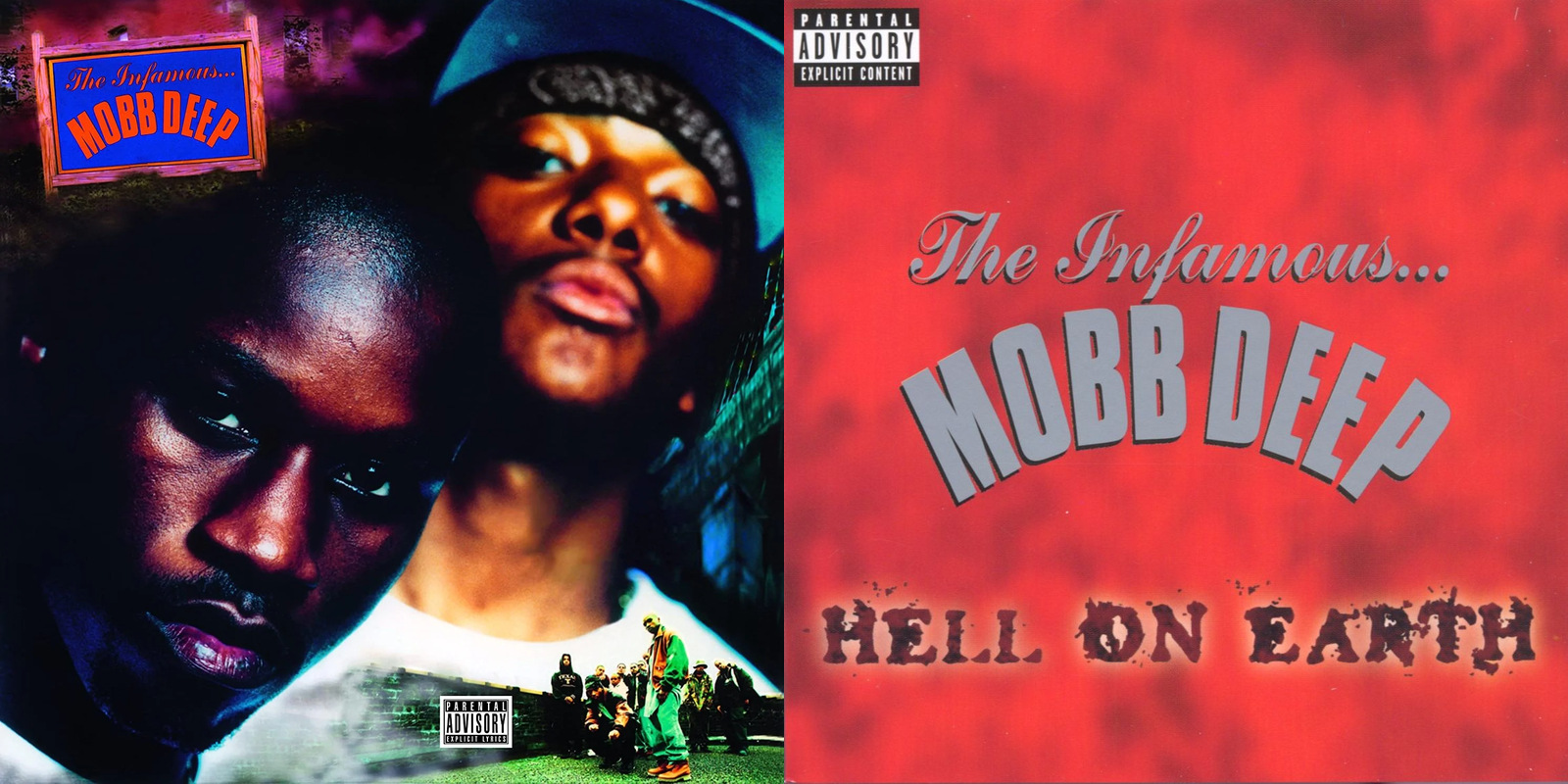
Some hip-hop groups have one undeniable classic.
Others are fortunate enough to release two.
Mobb Deep belong to the second category.
In 1995, Havoc and Prodigy released The Infamous, an album that helped redefine hardcore East Coast hip-hop.
A year later, they returned with Hell on Earth, a darker, colder and even more uncompromising record.
Both albums are essential pieces of New York hip-hop history.
Both feature extraordinary production.
And both capture Mobb Deep at an almost frightening creative level.
But which one is actually better?
Is The Infamous the duo’s masterpiece, or did Hell on Earth take their sound to another level?
The Infamous: Queensbridge Takes Over
Released in April 1995, The Infamous represented an extraordinary transformation for Mobb Deep.
Their debut album, Juvenile Hell, had introduced Havoc and Prodigy, but it hadn’t established them as major figures in New York hip-hop.
The Infamous changed everything.
From its opening moments, the album creates an atmosphere of tension and danger.
The drums are heavy.
The melodies are haunting.
The production feels cold and stripped down.
And the lyrics paint an uncompromising picture of street life.
But what makes the record remarkable is its sense of authenticity.
Havoc and Prodigy weren’t trying to sound like polished mainstream stars.
They were building a world that felt unmistakably connected to Queensbridge.
You could hear the neighborhood in the music.
And hip-hop was listening.
Shook Ones Pt. II: A Defining Moment
Some songs become hits.
Others become part of hip-hop history.
“Shook Ones, Pt. II” belongs firmly in the second category.
The haunting instrumental, the unforgettable opening and Prodigy’s cold delivery helped create one of the definitive East Coast rap records of the 1990s.
It’s the kind of song that needs almost no introduction.
The beat begins, and the atmosphere changes.
But The Infamous has much more to offer.
“Survival of the Fittest” carries the same sense of danger while exploring the pressures of life in an unforgiving environment.
“Temperature’s Rising” introduces a more emotional dimension.
“Give Up the Goods (Just Step)” demonstrates the duo’s ability to create a compelling groove without sacrificing their street identity.
“Eye for a Eye (Your Beef Is Mines)” brings together Mobb Deep, Nas and Raekwon for a memorable collaboration.
And “Right Back at You” adds Ghostface Killah, Raekwon and Big Noyd to the album’s already formidable lineup.
This is an album filled with classic moments.
The Production Was a Revolution
One of the main reasons The Infamous still sounds powerful is its production.
Havoc helped develop a sonic identity that countless artists would later draw inspiration from.
The beats were often built around unsettling samples, hard drums and minimal melodic elements.
Nothing sounded unnecessary.
Even the quieter moments carried tension.
The production also worked perfectly with Prodigy’s delivery.
His voice was controlled, direct and often chilling.
He didn’t need to shout to sound threatening.
The music created space for his words, and his words made the production feel even more dangerous.
That relationship between producer and MC is central to the album’s greatness.
Hell on Earth: Even Darker, Even Colder
Most artists would struggle to follow an album as influential as The Infamous.
Mobb Deep responded by making something even darker.
Released in 1996, Hell on Earth took the atmosphere of their previous record and pushed it into more hostile territory.
The production feels less welcoming.
The writing is more confrontational.
And the overall experience is almost relentlessly bleak.
If The Infamous sounded like two young artists describing the world around them, Hell on Earth sounded like two artists who had completely mastered the language of that world.
Havoc’s production became more focused and sinister.
Prodigy’s delivery sounded increasingly confident.
And the duo demonstrated that their earlier success hadn’t softened their approach.
Quite the opposite.
The Tracks That Make Hell on Earth a Classic
The album opens with “Animal Instinct,” immediately establishing its dark atmosphere.
“Drop a Gem on ‘Em” delivers sharp, confrontational lyricism.
“Nighttime Vultures,” featuring Raekwon, captures the bleak cinematic quality that runs through the project.
“G.O.D. Pt. III” stands out for its ominous production and unforgettable mood.
The title track, “Hell on Earth (Front Lines),” is one of the strongest demonstrations of Mobb Deep’s fully developed sound.
“Still Shinin'” gives Prodigy another opportunity to display the controlled aggression that made him one of his generation’s most respected MCs.
And “Apostle’s Warning” closes the album with a performance that reinforces just how commanding Prodigy had become.
For listeners who prefer their hip-hop raw, uncompromising and atmospheric, Hell on Earth is nearly impossible to beat.
Prodigy Was Reaching Another Level
The debate between these two albums often comes down to Prodigy’s development.
On The Infamous, he sounds hungry, talented and dangerous.
On Hell on Earth, he sounds even more assured.
His delivery is sharper.
His personality is more pronounced.
And his ability to make relatively simple phrases feel powerful is extraordinary.
Prodigy never needed to fill every bar with complicated wordplay.
His strength was making the listener believe every word carried weight.
Havoc, meanwhile, provided the perfect musical environment.
Together, they created a sound that few groups have ever replicated convincingly.
Which Album Has the Better Production?
This might be the hardest category to judge.
The Infamous has some of the most recognizable beats in East Coast hip-hop history.
“Shook Ones, Pt. II” and “Survival of the Fittest” alone would make an extraordinary case for its production.
The album also offers more variation in mood, with tracks that leave room for reflection alongside the darker material.
Hell on Earth takes a different approach.
Its production feels more unified, with almost every beat contributing to the same bleak atmosphere.
There is something impressive about that consistency.
The Infamous is arguably more varied and groundbreaking.
Hell on Earth may be more focused.
Neither approach is inherently superior.
It depends on what you’re looking for in a classic rap album.
Which Album Has the Better Songs?
When it comes to individual records, The Infamous has an enormous advantage.
“Shook Ones, Pt. II” is one of the most iconic rap songs ever recorded.
“Survival of the Fittest” is another defining classic.
Then there are “Temperature’s Rising,” “Eye for a Eye,” “Give Up the Goods” and the rest of the album’s remarkable supporting material.
Hell on Earth counters with “G.O.D. Pt. III,” “Drop a Gem on ‘Em,” “Nighttime Vultures,” “Hell on Earth (Front Lines)” and “Apostle’s Warning.”
It’s a formidable collection.
But if the question is which album contains the most historically recognizable songs, The Infamous probably wins.
Which Album Has the Stronger Atmosphere?
This is where Hell on Earth makes its strongest argument.
The Infamous is dark.
Hell on Earth feels almost suffocating.
The production, lyrics and sequencing create a sense of constant tension.
There is very little relief from the album’s bleak worldview.
For some listeners, that makes it harder to enjoy as a complete experience.
For others, it’s exactly what makes the record so special.
The entire album feels connected.
It doesn’t simply contain dark songs.
It creates a dark world.
And few hip-hop albums have ever done that more convincingly.
The Verdict: Which Mobb Deep Album Wins?
Our choice is The Infamous.
Not because Hell on Earth is significantly weaker.
And certainly not because Mobb Deep failed to evolve.
The Infamous wins because of its extraordinary combination of classic songs, historical influence, production and emotional range.
It’s the album that transformed Mobb Deep into legends.
It’s also a record whose sound helped redefine New York street rap.
But the difference is extremely small.
In terms of lyrical confidence, consistency and atmosphere, Hell on Earth might actually be the stronger album.
That is what makes this debate so interesting.
One album introduced a sound that changed hip-hop.
The other took that sound to its darkest and most uncompromising form.
Together, they represent one of the greatest consecutive album runs in East Coast rap history.
The Infamous may be Mobb Deep’s most important album. Hell on Earth might be their most complete.
And depending on the listener, those might not be the same thing.
Now It’s Your Turn
The Infamous (1995) or Hell on Earth (1996)?
Which album is Mobb Deep’s greatest masterpiece?
Is “Shook Ones, Pt. II” enough to give The Infamous the victory, or does Hell on Earth win through its darker production and Prodigy’s performances?
Drop your choice in the comments below — and tell us why.
Real hip-hop. Real stories. No compromise.