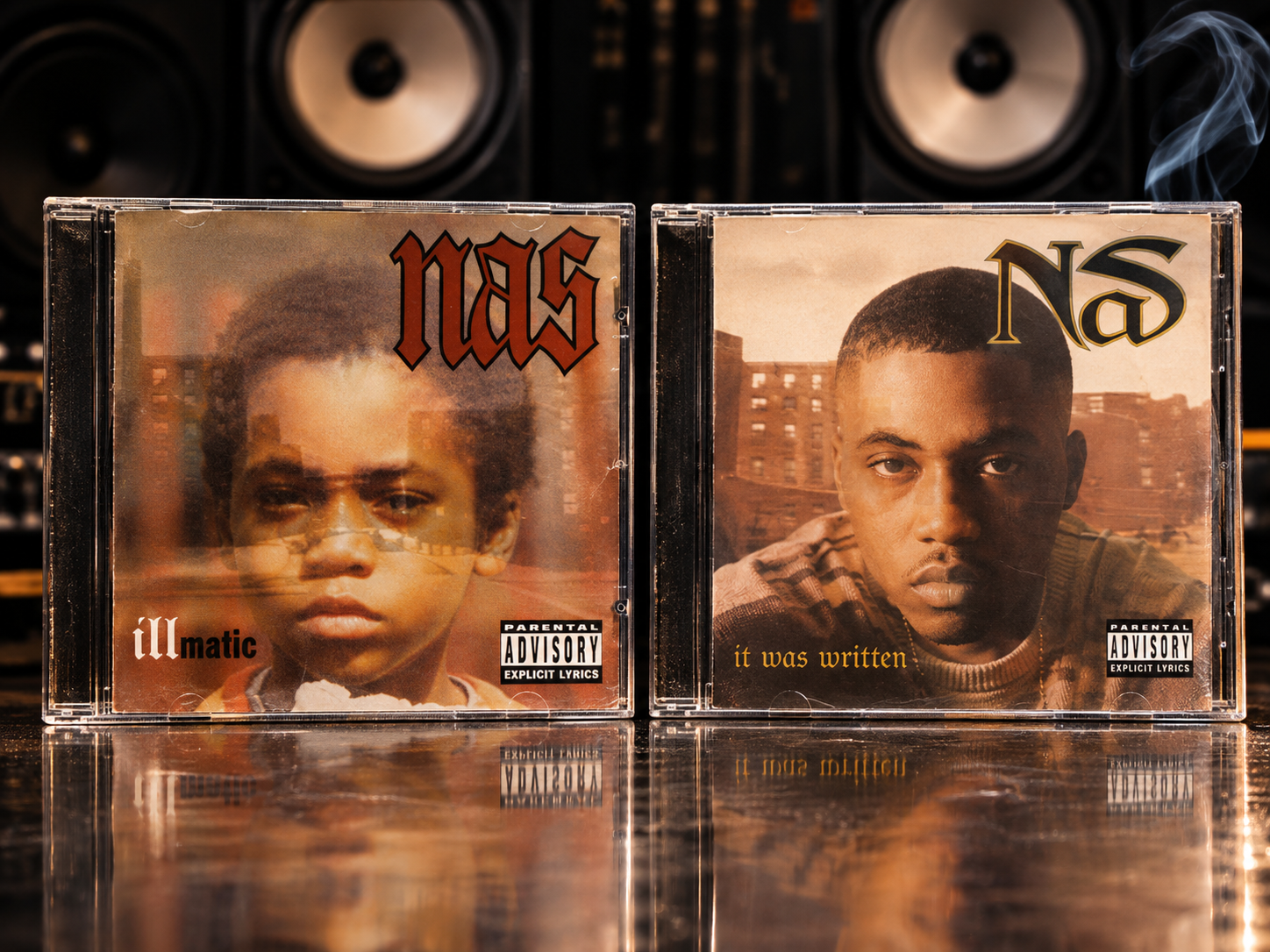
Some rappers spend their entire careers trying to make one classic album.
Nas made two before turning 23.
In 1994, Illmatic introduced the world to a young Queensbridge MC whose lyrical ability was almost impossible to believe.
Two years later, It Was Written took Nas to another level — commercially, musically and arguably as a storyteller.
But here’s where things get interesting.
For decades, Illmatic has been treated as one of the greatest hip-hop albums ever recorded. Its influence is undeniable, its production is legendary, and its reputation borders on untouchable.
Yet there’s another side to the story.
What if It Was Written is just as brilliant? What if Nas didn’t decline after Illmatic, but actually evolved?
Some hip-hop fans even consider It Was Written his finest work.
So let’s settle in for one of the most interesting debates in East Coast hip-hop history.
Illmatic vs. It Was Written. Which Nas album really deserves the crown?
Illmatic (1994): A Young Genius From Queensbridge
On April 19, 1994, Nas released his debut album, Illmatic.
He was just 20 years old.
And somehow, he sounded like someone who had already lived several lifetimes.
While other rappers were competing to deliver the hardest punchlines or the biggest radio hits, Nas painted vivid pictures of life in Queensbridge.
His lyrics were detailed, poetic and remarkably mature.
Every verse felt like a short film.
Every line carried meaning.
And behind him stood an extraordinary collection of producers.
DJ Premier. Pete Rock. Large Professor. Q-Tip. L.E.S.
Five distinctive production minds contributing to a record that somehow sounded completely unified.
That alone was remarkable.
But the real magic was the relationship between the music and Nas’ writing.
A Sound That Captured New York
Illmatic sounds like New York in the early 1990s.
Dusty drums.
Jazz samples.
Dark piano loops.
The sound of an entire city captured through one young man’s perspective.
On “N.Y. State of Mind,” Nas delivers an extraordinary display of storytelling over DJ Premier’s haunting production.
“The World Is Yours” brings optimism and reflection through Pete Rock’s unforgettable instrumental.
“Memory Lane (Sittin’ in da Park)” captures the nostalgic beauty of Queensbridge life.
“One Love” transforms letters to incarcerated friends into something deeply personal.
And “It Ain’t Hard to Tell” closes the album with one of Nas’ most confident lyrical performances.
Then there’s “Life’s a Bitch.”
AZ delivers one of the most celebrated guest verses in hip-hop history, while Nas reflects on life, ambition and mortality.
And let’s not forget Olu Dara’s trumpet contribution at the end.
It’s these details that helped turn Illmatic into something extraordinary.
Ten Tracks. Almost No Wasted Moments.
One of Illmatic’s greatest strengths is its focus.
The album contains just ten tracks, including its introduction.
There are no lengthy attempts to chase different audiences.
No unnecessary radio-friendly collaborations.
No dramatic changes in musical direction.
Everything feels carefully connected.
You can listen to the record from beginning to end without feeling that a single song is out of place.
And perhaps that’s why its reputation has only grown stronger.
Illmatic wasn’t simply a collection of great songs. It was a complete artistic statement.
But despite the extraordinary critical acclaim, its initial commercial performance was relatively modest compared with the biggest rap albums of the era.
The album reached No. 12 on the Billboard 200.
Its influence would eventually become enormous, but its commercial breakthrough wasn’t immediate.
And that brings us to 1996.
It Was Written (1996): Nas Becomes a Superstar
On July 2, 1996, Nas released his second album, It Was Written.
The difference was immediately noticeable.
The production was cleaner.
The arrangements were more cinematic.
The themes were darker in some ways, but the presentation was also more accessible.
And Nas himself sounded different.
He was no longer simply the young poet observing the streets of Queensbridge.
He had become Nas Escobar.
A storyteller who increasingly explored organized crime, wealth, power, betrayal and the consequences of ambition.
The mafioso influence was clear.
But dismissing the album as an attempt to follow a popular trend would overlook some of the finest writing of Nas’ career.
It Was Written wasn’t Illmatic Part Two. And that was exactly the point.
The Commercial Success Was Massive
Let’s talk numbers.
When Illmatic arrived in 1994, it sold approximately 59,000 copies during its opening week and debuted at No. 12 on the Billboard 200.
It Was Written was a completely different story.
The sophomore album sold approximately 270,000 copies in its first week.
It debuted at No. 1 on the Billboard 200.
And it remained at the top for four consecutive weeks.
The album eventually achieved triple-platinum certification in the United States, becoming the biggest commercial success of Nas’ career.
That was a remarkable achievement.
For an artist whose debut had earned enormous respect from hip-hop purists without dominating mainstream sales, It Was Written represented a major transformation.
Nas was no longer simply one of New York’s most respected lyricists.
He was a genuine superstar.
But commercial success created a new problem.
Some longtime fans began questioning whether Nas had changed too much.
The Great Debate: Did Nas Sell Out?
This is where the story becomes complicated.
Illmatic had established Nas as a symbol of pure East Coast lyricism.
The production was gritty.
The writing was uncompromising.
And the album felt deeply connected to the underground New York scene.
When It Was Written arrived with polished production from the Trackmasters, a more cinematic image and major crossover singles, some listeners were skeptical.
Was Nas chasing radio success?
Was he abandoning the sound that made Illmatic special?
Or was he simply refusing to record the same album twice?
There’s a strong argument for the third explanation.
Because when you actually listen to It Was Written, the lyrical ability hasn’t disappeared.
If anything, Nas sounds even more confident.
The storytelling is more elaborate.
His vocabulary remains extraordinary.
And some of his most technically impressive performances appear on this very album.
The difference isn’t necessarily the quality of the writing.
It’s the world he’s writing about.
The Message: A Perfect Opening Statement
After the introduction, It Was Written begins with “The Message.”
And what an opening.
The production is melodic and atmospheric, while Nas delivers one of his most memorable performances.
His flow is controlled.
His wordplay is sharp.
And his confidence is unmistakable.
The track immediately establishes the album’s new identity.
This isn’t the same young artist who recorded Illmatic.
This is a rapper who knows exactly how good he is.
For many fans, “The Message” alone is enough to challenge the idea that Nas’ best lyricism only existed on his debut.
I Gave You Power: Storytelling at Its Finest
If someone argues that It Was Written sacrificed lyrical substance for commercial appeal, play them “I Gave You Power.”
Produced by DJ Premier, the track features Nas telling a story from the perspective of a firearm.
Think about how difficult that concept is to execute convincingly.
The narrator isn’t simply describing violence.
The gun itself becomes a character, reflecting on the destruction surrounding it.
It’s creative.
It’s disturbing.
And it’s a remarkable example of conceptual storytelling.
There are very few records in hip-hop history that approach the subject quite this way.
“I Gave You Power” deserves to stand alongside the finest storytelling tracks Nas has ever recorded.
And it appeared on the album that some people still dismiss as too commercial.
That contradiction says a lot.
Take It in Blood: The Nas That Purists Love
Another essential track is “Take It in Blood.”
Dark, hypnotic and filled with intricate rhymes, the song represents the side of It Was Written that longtime Nas fans often celebrate.
There’s no attempt to create a huge radio anthem.
No obvious crossover formula.
Just Nas delivering extraordinary verses over an atmospheric beat.
It’s the kind of recording that makes you appreciate how naturally complex his writing could be.
In many ways, “Take It in Blood” feels like a bridge between the worlds of Illmatic and It Was Written.
The production belongs to the darker, more polished atmosphere of the second album.
But the lyrical hunger is unmistakably the same.
Affirmative Action: The Birth of The Firm
Then there’s “Affirmative Action.”
Featuring AZ, Cormega and Foxy Brown, the track became one of the most memorable posse cuts of the era.
The chemistry is extraordinary.
Each artist brings a different personality to the record.
And the mafioso storytelling feels like a cinematic crime drama.
The collaboration also helped introduce the idea of The Firm, the hip-hop supergroup that would later develop into a separate project.
What’s especially interesting is how different this record sounds from Illmatic.
Nas isn’t simply recounting life in Queensbridge anymore.
He’s creating a larger fictional universe filled with organized crime, ambition and complicated alliances.
Some listeners prefer the realism of his debut.
Others enjoy the cinematic ambition of his second album.
Neither preference is unreasonable.
If I Ruled the World: The Song That Changed Everything
Of course, we have to talk about “If I Ruled the World (Imagine That).”
Featuring Lauryn Hill, the song became one of Nas’ most recognizable records.
It was melodic.
It was accessible.
And it reached an audience far beyond the underground hip-hop community.
For some purists, that accessibility represented the direction they feared Nas was taking.
But listen beyond the chorus.
The song still explores freedom, injustice, aspiration and the possibility of a better world.
Those ideas weren’t foreign to Nas.
They were simply being expressed through a different musical approach.
Lauryn Hill’s contribution helped make the song unforgettable.
And its success demonstrated that Nas could reach mainstream listeners without abandoning meaningful subject matter.
“Street Dreams” pushed his commercial profile even further.
Suddenly, Nas wasn’t only being discussed among dedicated hip-hop fans.
His music was reaching a much larger audience.
And that mattered.
The Production: Raw New York vs. Cinematic Hip-Hop
The biggest difference between the two albums may be their production.
Illmatic is built around dusty jazz samples, stripped-down drums and the unmistakable atmosphere of early-’90s New York.
DJ Premier, Pete Rock, Q-Tip, Large Professor and L.E.S. helped create a sound that remains almost impossible to imitate.
The beats are timeless because they feel so natural.
It Was Written takes a different approach.
With significant contributions from the Trackmasters alongside producers including DJ Premier, Dr. Dre, Havoc and L.E.S., the music becomes smoother, more layered and more cinematic.
The album moves between haunting street records and polished crossover songs.
And there’s something impressive about that versatility.
On Illmatic, the production serves the experience of one neighborhood and one young narrator.
On It Was Written, the production supports a larger musical universe.
One feels intimate.
The other feels expansive.
Illmatic captures the streets. It Was Written turns them into a movie.
That’s perhaps the simplest way to explain the difference.
Which Album Has the Better Lyrics?
Now we’re entering dangerous territory.
Because Nas is extraordinary on both albums.
On Illmatic, his writing feels spontaneous, detailed and astonishingly mature.
The storytelling has a documentary quality.
You feel like you’re walking through Queensbridge alongside him.
On It Was Written, his rhymes often become more elaborate.
The imagery is more cinematic.
The narratives are more ambitious.
And his confidence has clearly developed.
Songs like “The Message,” “I Gave You Power,” “Take It in Blood” and “Shootouts” demonstrate a rapper operating at an exceptional level.
Some listeners believe Illmatic captures Nas at his most natural and authentic.
Others argue that It Was Written features his most sophisticated writing.
And that’s what makes the debate so interesting.
Could the album with the more polished production actually contain some of Nas’ greatest lyrical performances?
Absolutely.
Which Album Has the Better Tracks?
Let’s put the classics side by side.
Illmatic
- “N.Y. State of Mind”
- “The World Is Yours”
- “Life’s a Bitch”
- “Memory Lane (Sittin’ in da Park)”
- “One Love”
- “Represent”
- “It Ain’t Hard to Tell”
It Was Written
- “The Message”
- “Street Dreams”
- “I Gave You Power”
- “Take It in Blood”
- “Affirmative Action”
- “Shootouts”
- “Live Nigga Rap”
- “If I Ruled the World (Imagine That)”
Look at those songs.
We’re talking about two extraordinary collections of hip-hop music.
Illmatic arguably has the advantage in consistency, with its shorter running time and almost flawless sequencing.
It Was Written arguably offers greater range, with more elaborate storytelling, bigger collaborations and more variation in production.
The question becomes personal.
Do you prefer an album that delivers an almost perfect 40-minute experience?
Or one that explores more musical territory and provides a wider selection of memorable moments?
Why It Was Written Deserves Classic Status
Here’s something we feel strongly about at WhatsRap.
It Was Written shouldn’t have to be better than Illmatic to be considered a classic.
That might sound obvious, but the album has spent decades living in the shadow of Nas’ debut.
And that’s unfair.
Think about what the record accomplished.
It introduced some of the finest storytelling Nas ever recorded.
It demonstrated tremendous lyrical growth.
It delivered unforgettable collaborations.
It brought him his first No. 1 album.
And it became his biggest commercial success.
How many rappers would love to have a second album with that combination of artistic ambition and commercial achievement?
The fact that Nas had already released Illmatic shouldn’t diminish the accomplishment.
If another rapper had released It Was Written as his debut, would listeners discuss it differently?
Would it receive even greater recognition?
It’s worth thinking about.
What Do Hip-Hop Fans Actually Prefer?
Among hip-hop fans, Illmatic generally has the stronger reputation.
Its influence, production and consistency make it a frequent choice in discussions about the greatest rap albums ever recorded.
But It Was Written has a deeply committed following.
Fans who prefer the second album often point to the more advanced storytelling, cinematic production and the extraordinary level of lyricism displayed throughout the record.
Some grew up with “If I Ruled the World” and “Street Dreams.”
Others were drawn to darker tracks such as “Take It in Blood,” “The Message” and “I Gave You Power.”
And some listeners simply prefer the Nas Escobar era.
There have been fan polls favoring Illmatic, but those results don’t settle the question for every listener.
The debate has continued for three decades.
That’s a pretty strong indication that both albums have something special.
And perhaps the most interesting thing is that the records appeal to different sides of the same hip-hop audience.
One represents the hunger of a young genius.
The other represents his transformation into a superstar.
The WhatsRap Verdict: Two Classics, One Impossible Choice
If we’re judging historical influence, Illmatic has the edge.
Its impact on East Coast lyricism, production and hip-hop culture is almost impossible to overstate.
If we’re judging commercial success, It Was Written wins comfortably.
Its No. 1 debut, four weeks at the top and eventual triple-platinum status transformed Nas’ career.
If we’re judging storytelling and lyrical complexity, the debate becomes much more difficult.
Illmatic is raw, intimate and remarkably consistent.
It Was Written is cinematic, confident and filled with extraordinary writing.
And if we’re judging which album is more enjoyable?
That’s entirely up to the listener.
Our position at WhatsRap is simple:
Illmatic is a masterpiece. But It Was Written is absolutely a classic in its own right.
It should never be dismissed simply because it followed one of the most celebrated debut albums in hip-hop history.
In 1994, Nas showed the world what a young genius from Queensbridge could accomplish.
In 1996, he demonstrated that his talent could reach millions without losing its ability to surprise us.
Illmatic made Nas a legend. It Was Written made him a superstar.
And together, they represent one of the greatest one-two punches in hip-hop history.
Now It’s Your Turn: Illmatic or It Was Written?
We’re putting this debate in the hands of the WhatsRap community.
If you could only keep ONE Nas album forever, which would it be?
ILLMATIC (1994) or IT WAS WRITTEN (1996)?
Which album has the better production?
Where do you think Nas delivered his finest lyrics?
And which record do you still play more often?
Drop your vote in the comments below and tell us WHY!
Don’t just follow the popular opinion. We want to hear what the real hip-hop heads think.
Real hip-hop. Real stories. No compromise.